

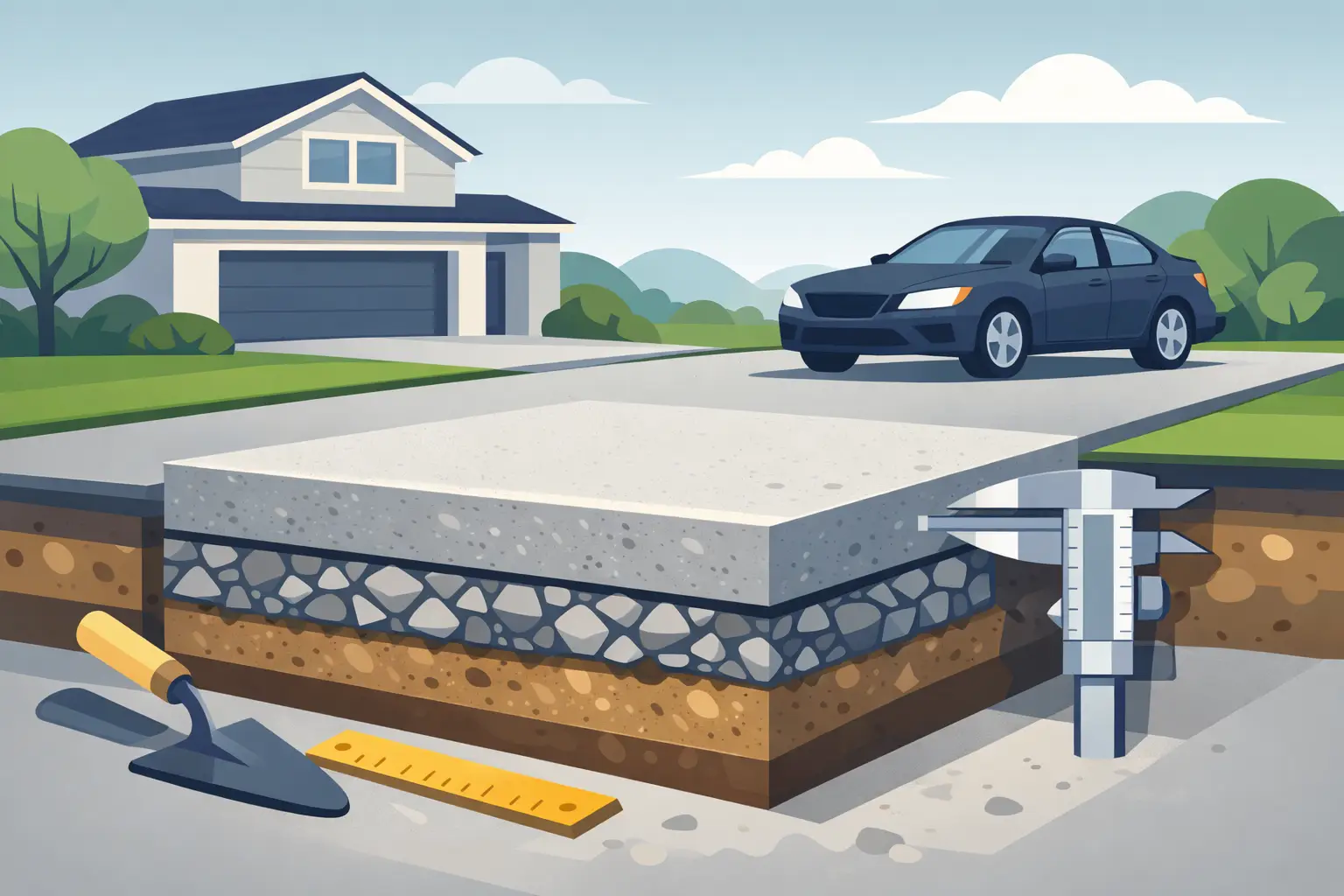
A driveway can look perfectly fine on day one and still fail early if the slab is too thin for the traffic it carries. If you are asking how thick should concrete driveway be, the short answer is that most residential driveways should be 4 inches thick, but that is not the whole story. Vehicle weight, soil conditions, reinforcement, drainage, and base preparation all affect whether 4 inches is enough or whether a thicker slab is the smarter investment.
How thick should concrete driveway be for most homes?
For a typical single-family home with normal passenger vehicles, 4 inches of concrete is the standard recommendation. That thickness is widely used because it gives a good balance of strength, durability, and cost. For many homeowners, it performs well for years when the driveway is installed over a properly compacted base and finished with correct joints.
Where people run into trouble is assuming thickness alone carries the whole job. A 4-inch driveway on weak subgrade or poor drainage can crack and settle sooner than a 5-inch driveway built correctly. Good concrete work depends on the full system under and within the slab, not just the visible surface.
If the driveway will regularly support heavier vehicles, 5 to 6 inches is usually the safer choice. That matters for large pickups, delivery vans, RVs, work trucks, trailers, and properties where service vehicles visit often. If you own a small business or manage a property with repeated heavier traffic, going thicker up front can help avoid expensive repairs later.
When 4 inches is enough and when it is not
A standard 4-inch slab generally works well for sedans, SUVs, and light-duty pickup trucks used at a normal household frequency. If your driveway is mainly a route from the street to the garage and does not carry unusually heavy loads, this thickness is often appropriate.
It becomes less ideal when the driveway sees concentrated weight in the same spots. That includes parking a loaded truck in one place every day, backing a trailer into the same area, or having garbage, moving, or contractor vehicles use the driveway often. Heavy point loads increase the stress on the concrete and can lead to cracking, edge failure, or surface breakdown.
That is why many contractors recommend 5 inches for extra durability even on some residential jobs. The cost increase is usually modest compared to the overall project, but the added strength can make sense if you want a longer-lasting surface and less risk from occasional heavy traffic.
Thickness by use case
For most homes, 4 inches is the baseline. For driveways used by heavier personal vehicles or occasional commercial traffic, 5 inches is often a better fit. For areas that may see regular heavier vehicles, 6 inches may be warranted, especially near the apron, parking pad, or turnaround where weight and tire stress tend to concentrate.
There is also a practical middle ground. Some driveways are poured at a standard thickness overall but made thicker in high-stress sections. That can be a smart approach if you want better performance without overbuilding the entire slab.
The base matters almost as much as the slab
A concrete driveway is only as stable as the material beneath it. Even the right answer to how thick should concrete driveway be can fall short if the base is poorly prepared. Before any concrete is poured, the soil should be evaluated, graded correctly, and compacted. In many cases, a compacted gravel or crushed stone base is added to improve stability and drainage.
A solid base helps distribute vehicle loads and reduces the chance of settling. It also helps water move away instead of getting trapped beneath the slab. When water sits under concrete and the ground softens, the slab becomes more vulnerable to cracking and uneven movement.
Expansive or weak soils deserve extra attention. In some areas, clay-heavy soil can swell when wet and shrink when dry, which puts stress on the driveway over time. In those conditions, a contractor may recommend additional base work, a thicker slab, or both.
Reinforcement helps, but it does not replace thickness
Homeowners sometimes hear that rebar or wire mesh means they can pour thinner concrete. That is usually the wrong way to think about it. Reinforcement helps control cracking and improves load distribution, but it does not turn an undersized slab into a durable one.
Wire mesh or rebar can add structural support when used correctly, especially on driveways expected to handle heavier traffic. Fiber-reinforced concrete is another option that can help reduce shrinkage cracking. The best reinforcement choice depends on the driveway design, the base conditions, and the intended use.
The key point is simple. Reinforcement is there to improve performance, not to excuse cutting corners on depth.
Control joints, drainage, and finishing affect lifespan too
Concrete naturally cracks as it cures and responds to temperature changes. Control joints are cut or formed so those cracks happen in planned locations instead of randomly across the driveway. If joints are spaced poorly or installed too late, the driveway may crack in places you did not expect.
Drainage is just as important. Water should move away from the driveway and away from the home or garage. If water runs under the slab or pools along the edges, it can weaken support and shorten the life of the installation.
Surface finishing also plays a role in real-world performance. A broom finish is common for driveways because it adds traction and handles weather well. Decorative options like stamped concrete can also work for driveways, but they need to be designed and installed with vehicle traffic in mind. Appearance matters, but durability has to come first on any surface that carries weight every day.
Is thicker concrete always better?
Not automatically. A thicker driveway usually offers more strength, but there is a point where added depth does not deliver much practical benefit for a standard home. If your driveway only handles normal household vehicles, jumping from 4 inches to 6 inches may add cost without solving any real problem.
The better question is whether the slab thickness matches the actual demands of the property. A well-installed 4-inch driveway can outperform a poorly built 6-inch one. Thicker concrete makes the most sense when the traffic, soil, or use pattern justifies it.
This is where an experienced installer adds value. Instead of giving every property the same recommendation, a good contractor looks at grade, drainage, access, turning areas, parking habits, and the types of vehicles expected to use the driveway.
How to know what your property needs
If you are replacing an old driveway, the condition of the existing slab can tell you a lot. Repeated cracking in wheel paths, broken edges, sinking sections, or apron damage often point to either inadequate thickness, poor base preparation, or both. Simply repouring to the same specs may repeat the same problem.
It also helps to think ahead. Maybe you do not own an RV today, but you plan to. Maybe your work truck stays parked at home. Maybe delivery traffic has increased, or the driveway serves a small commercial property where vehicle loads are less predictable. Those details affect the right recommendation.
For many residential projects, the safest practical answer is this: 4 inches is standard, 5 inches adds peace of mind, and 6 inches is for heavier-duty use. The right choice depends on how the driveway will actually be used, not just what is cheapest on paper.
Cost versus long-term value
Every extra inch of concrete increases material cost, and thicker slabs may also require more labor and stronger edge support. That said, driveway replacement is not a project most property owners want to do twice. Paying a bit more for proper depth and preparation can be more cost-effective than dealing with premature cracking, patching, or full replacement.
That is especially true if curb appeal matters. A driveway is one of the largest hardscape surfaces on the property, and when it starts to fail, it affects both appearance and function. A clean, well-built concrete driveway supports the overall look of the home and gives you a surface that performs the way it should.
At Greenstone Landscaping Co, we look at concrete work the same way we approach outdoor improvements in general - it needs to look good, hold up, and fit how the property is actually used.
If you are deciding how thick your new driveway should be, do not focus only on the number. Focus on the full build: the traffic it will carry, the strength of the base, the drainage around it, and the quality of the installation. The right thickness is the one that gives you a driveway you do not have to second-guess every time a heavier vehicle pulls in.