404-547-5771
Concrete Driveway Cost in Johns Creek, GA: 2026 Pricing Guide
HomeBlogConcreteConcrete Driveway Cost in Johns Creek, G…
Concrete

Concrete Driveway Cost in Johns Creek, GA: 2026 Pricing Guide

7 min readUpdated

Concrete driveways in Johns Creek, GA cost $5 to $20 per square foot installed in 2026. Johns Creek's HOA-dense subdivisions and premium North Fulton market mean curb appeal matters — here is the complete local pricing guide.

Greenstone Landscaping LLC
Concrete & Landscape ContractorsNortheast Georgia

Johns Creek is one of the most competitive real estate markets in Georgia — and your driveway is the first thing every buyer, guest, and HOA inspector sees. Whether you are in St. Ives Country Club, Medlock Bridge, Abbotts Bridge, Rivermont, or any of Johns Creek's dozens of established subdivisions, this guide gives you the complete 2026 pricing picture for a concrete driveway in Johns Creek, GA so you can budget accurately and hold any contractor accountable.

Concrete Driveway Cost in Johns Creek, GA (2026)

  • Standard broom finish: $5 to $8 per sq ft installed
  • Exposed aggregate finish: $7 to $11 per sq ft installed
  • Stamped concrete driveway: $11 to $16 per sq ft installed
  • Premium stamped + integral color + UV sealer: $14 to $20 per sq ft installed
  • Colored concrete with decorative border: $8 to $13 per sq ft installed
  • Demolition of existing driveway (add to above): $2 to $4 per sq ft
  • Rebar reinforcement upgrade: $0.50 to $1.00 per sq ft

Johns Creek and North Fulton County rates run 8 to 12% higher than rural Georgia markets. For a typical two-car driveway of 600 sq ft, budget $3,000 to $4,800 for a quality broom finish or $6,600 to $12,000 for stamped concrete — all-in including demolition, base prep, reinforcement, pour, and finish.

2026 PricingFree On-Site Estimate

Planning a driveway project in Johns Creek? We provide free on-site estimates with detailed written quotes including base specs, reinforcement details, and pattern samples for stamped projects. Same-week appointments across all of North Fulton County.

Most Popular Driveway Finishes in Johns Creek

Stamped Concrete — The HOA Subdivision Standard

Stamped concrete dominates the Johns Creek driveway market. In HOA communities like St. Ives, Medlock Bridge, and Abbotts Bridge, the driveway is a primary component of your home's exterior presentation — and stamped concrete delivers the visual quality that matches North Fulton home values. The most popular Johns Creek patterns are cobblestone, ashlar slate in large-format layouts, and European fan patterns. Charcoal with a sandstone base color is the most frequently requested combination, complementing the brick and stone home exteriors common throughout North Fulton.

Exposed Aggregate — Premium Low-Maintenance

Exposed aggregate has a strong following in Johns Creek among homeowners who want a premium, stone-like appearance without the resealing schedule of stamped concrete. White quartz and gray granite stone mixes are popular in the North Fulton market. Exposed aggregate requires resealing every 3 to 4 years rather than 2 to 3 for stamped — a meaningful maintenance advantage on wider or longer Johns Creek driveways.

Colored Concrete with Decorative Border — Mid-Range Impact

An increasingly popular mid-range option in Johns Creek's newer developments: integral color throughout the slab with a stamped border pattern framing the edges. Gives a custom, finished look at $8 to $13 per sq ft — significantly more distinctive than plain broom finish without the full-surface stamping cost.

HOA Considerations for Driveway Projects in Johns Creek

This is where Johns Creek driveway projects differ most from other Georgia markets. Most Johns Creek subdivisions have strict HOA covenants governing:

  • Approved driveway materials — some HOAs restrict colors, patterns, or finishes
  • Driveway width and setback requirements — widening a driveway may require HOA approval
  • Contractor licensing and insurance requirements — many Johns Creek HOAs require proof before work can begin
  • Timeline requirements — some HOAs require project completion within 30 to 60 days of ground disturbance
  • Appearance standards — cracked or deteriorated driveways can generate HOA violation notices

Johns Creek HOA Tip: Always submit your driveway project to your HOA architecture review committee before signing a contractor contract. Most committees meet monthly — factor this into your project timeline. Greenstone asks about your specific HOA requirements during every estimate visit and provides the documentation most Johns Creek HOAs need for approval.

Typical Driveway Project Costs in Johns Creek

  • Single-car driveway (300 to 400 sq ft, broom finish): $1,500 to $3,200
  • Two-car driveway (500 to 700 sq ft, broom finish): $2,500 to $5,600
  • Two-car driveway (500 to 700 sq ft, exposed aggregate): $3,500 to $7,700
  • Two-car driveway (500 to 700 sq ft, stamped): $5,500 to $11,200
  • Two-car + front walkway + apron (800 to 1,000 sq ft, stamped): $8,800 to $20,000
  • Full replacement including demolition (600 sq ft, stamped): $7,800 to $14,400 all-in
  • Long estate driveway (1,200 to 1,800 sq ft, stamped): $13,200 to $36,000

What a Quality Johns Creek Driveway Installation Includes

  • Full site excavation to minimum 8 inches below finished driveway elevation
  • 4 to 6 inch compacted crusher run gravel base — minimum 5 inch recommended for North Fulton clay
  • #4 rebar on 18-inch grid throughout — not wire mesh alone
  • Expansion joints at all garage door interfaces and every 10 feet of run
  • 4,000 PSI concrete mix minimum — 4,500 PSI for driveways subject to heavy vehicle loads
  • Full pattern and color sample review and approval before pour on stamped projects
  • UV-resistant sealer application within 28 days of cure
  • Written workmanship warranty on all completed work

What Drives Driveway Cost Up in Johns Creek?

North Fulton Clay Soil

Johns Creek sits on the Georgia Piedmont's red clay belt — highly expansive soil that swells in wet weather and contracts in dry spells. This soil movement is the primary cause of premature driveway cracking in Johns Creek when base preparation is inadequate. A minimum 5-inch compacted gravel base and rebar reinforcement throughout are non-negotiable for driveways expected to last 25+ years in this market.

HOA Compliance Documentation

Johns Creek HOA projects require more pre-construction coordination than standard Georgia driveway jobs. This includes architecture review submissions, contractor licensing verification, insurance certificates, and sometimes post-completion inspections. Reputable contractors build this administrative time into their quotes.

Topography and Driveway Length

Johns Creek's rolling terrain creates significant grade changes across the city — particularly in the St. Ives and Abbotts Bridge corridors. Sloped driveways require additional grading, and longer driveways in established neighborhoods add both material and labor cost. Equipment access on narrow private drives can also increase labor time.

Permit Requirements

The City of Johns Creek requires land disturbance permits for new driveway installations and significant replacements. Permit processing typically takes 5 to 10 business days. Your contractor should handle permit applications as part of the project — if they say no permit is needed for a new driveway, verify this directly with the City of Johns Creek Community Development Department.

Concrete Driveway vs. Asphalt in Johns Creek — Quick Comparison

Johns Creek HOAs typically prefer or require concrete over asphalt for aesthetic consistency. But even setting HOA requirements aside, concrete makes more sense in the Johns Creek market:

  • Concrete: $5 to $20 per sq ft installed, lasts 25 to 35 years, no summer softening, aesthetically premium
  • Asphalt: $3 to $5 per sq ft installed, lasts 15 to 20 years, softens in Georgia summer heat, requires sealing every 3 to 5 years
  • HOA factor: Most Johns Creek subdivisions explicitly prefer or require concrete
  • Resale value: Concrete driveways are a positive feature in North Fulton appraisals; asphalt is neutral at best

How Long Do Concrete Driveways Last in Johns Creek?

A properly installed concrete driveway in Johns Creek should last 25 to 35 years. The critical durability factors on North Fulton's clay-heavy soil are: a 4 to 6 inch compacted gravel base, #4 rebar reinforcement throughout, control joints placed every 10 feet, and regular sealing every 2 to 3 years for stamped or colored concrete. Driveways that fail prematurely in Johns Creek almost always trace back to inadequate base depth or wire mesh used instead of rebar.

Johns Creek Neighborhoods Served

Greenstone Landscaping LLC installs concrete driveways throughout Johns Creek and all of North Fulton County — St. Ives Country Club, Medlock Bridge, Rivermont, Abbotts Bridge, Shakerag, Technology Park area, Quail Hollow, Nesbit Ferry corridor, and all surrounding communities. We also serve adjacent Alpharetta, Roswell, Cumming, and upper Gwinnett County. Free, same-week on-site estimates. Call 404-547-5771 or fill out our contact form.

Frequently Asked Questions

Free Estimate

Ready to get started in Georgia?

We serve Loganville, Athens, Buford, Suwanee, Jefferson, and 15+ more Georgia communities.

Get a Free Quote 404-547-5771
Concrete Services

Driveways, stamped patios, repair & resurfacing — free on-site estimates across Georgia.

View Concrete Services
Free · No Obligation·Response within 24 hrs
Book a Free On-Site EstimateCall 404-547-5771
2026 Pricing Guide
Get an accurate quote for your project — free, no obligation

Home Landscaping Services That Add Value

Home Landscaping Services That Add Value

A yard usually starts causing problems long before it becomes an eyesore. Water pools near the driveway, the front entry feels bare, the patio is too small to use comfortably, or the lawn never fills in the way it should. That is where home landscaping services make a real difference. The right team does more than tidy up a property. They help shape outdoor space so it looks better, works better, and holds up over time.

For most homeowners and property managers, the biggest value is not just appearance. It is having one reliable company handle the planning and the work without forcing you to coordinate a designer, concrete contractor, planting crew, and installer separately. When the work is approached as one complete project, the result is usually cleaner, more practical, and easier to maintain.

What home landscaping services should actually include

The term gets used loosely, which can make it hard to compare companies. Some providers focus only on basic yard cleanup, while others handle full outdoor improvement projects. If your goal is a noticeable upgrade, home landscaping services should cover both visual design and the structural elements that make the space functional.

That often starts with layout and design. A good plan considers how people move through the property, where drainage needs to go, which areas should be planted, and where hard surfaces belong. A front yard needs curb appeal, but it also needs clear access, balance, and materials that fit the home. A backyard needs to be usable, not just attractive from a distance.

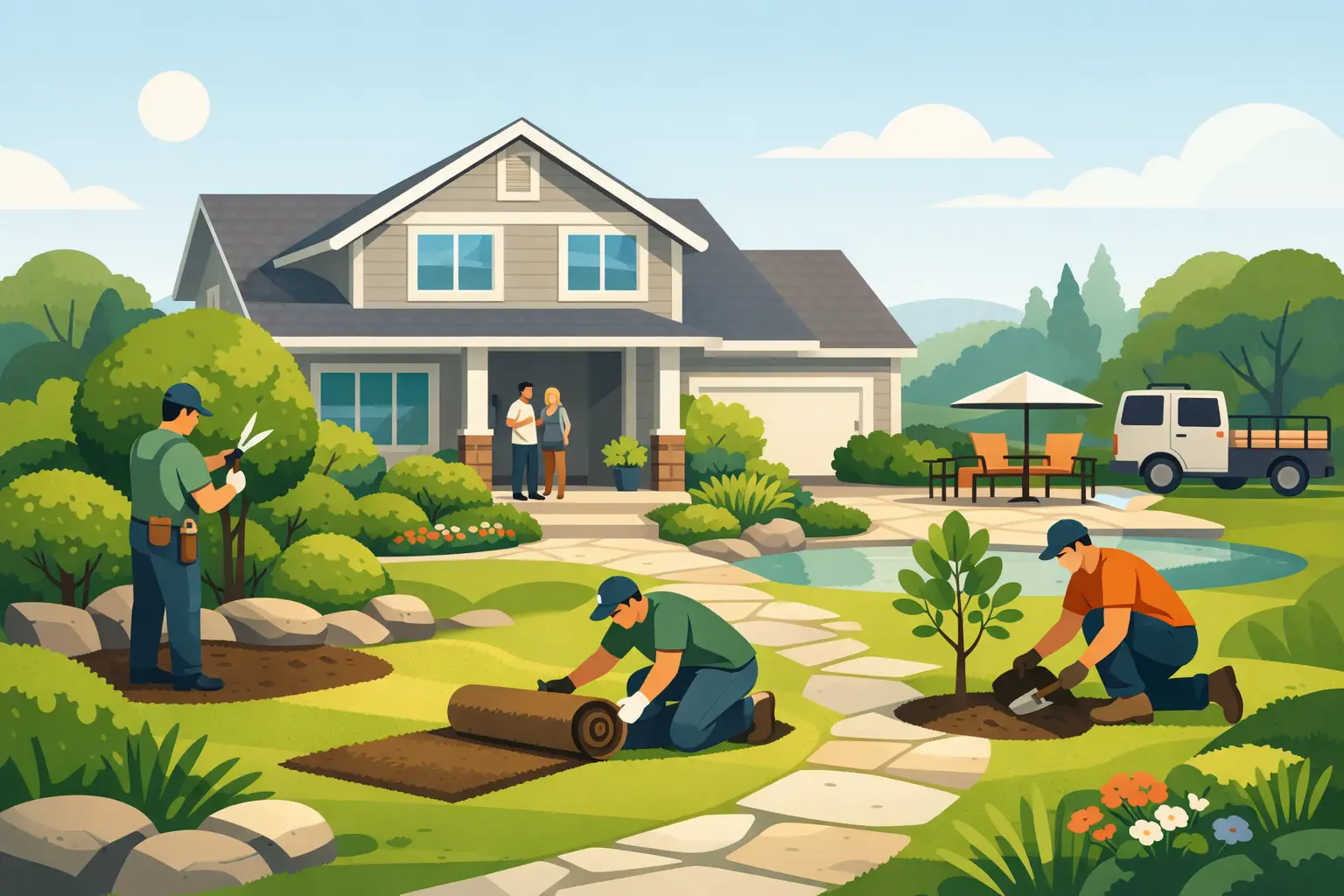
From there, installation becomes the difference-maker. Planting can soften the property and add color, but hardscape work gives the yard structure. Concrete patios, stamped concrete patios, walkways, and concrete driveways create the surfaces people actually use every day. Sod installation can quickly turn a patchy lot into a finished lawn, but it works best when grading and prep are handled correctly first.

Why full-service home landscaping services matter

Hiring separate contractors for each part of an outdoor project can look cheaper at first. Sometimes it is. But it can also create avoidable problems. One crew may pour a patio without considering nearby planting beds. Another may install sod without fixing drainage. A third may choose materials that do not match the style of the home.

Full-service home landscaping services help avoid those gaps. When one company is responsible for design, hardscape installation, planting, sod, and concrete work, the finished property usually feels more cohesive. There is also clearer accountability. If something needs adjustment, you are not sorting out which subcontractor caused the issue.

This matters even more on properties where outdoor space has to do more than look nice. A patio should fit the way your family uses it. A driveway should improve access and stand up to regular wear. Beds and borders should frame the home instead of making the yard feel crowded. Good landscaping is visual, but it is also practical.

The outdoor upgrades that make the biggest impact

Not every project needs a full redesign. In many cases, a few well-chosen improvements create a dramatic change.

Concrete patios are one of the most useful upgrades because they add livable square footage outside. A small backyard can feel much larger once there is a defined area for seating, grilling, or gathering. Stamped concrete patios add more character when homeowners want a finished look that feels elevated without moving into more expensive natural materials.

Concrete driveways are another major improvement, especially when the current surface is cracked, stained, uneven, or simply too narrow for everyday use. A new driveway improves first impressions, but it also solves real access and safety issues. That balance of appearance and function is where the best outdoor investments tend to pay off.

Planting has a different role. It gives the property softness, depth, and seasonal interest. But planting works best when it supports the overall layout instead of trying to carry the entire design on its own. Clean bed lines, properly placed shrubs, and the right mix of scale and color will usually outperform a crowded yard full of random selections.

Sod installation is often the fastest way to finish a property that looks incomplete. It creates an immediate, uniform lawn, which is especially appealing after construction or major renovations. Still, sod is not a shortcut for bad prep. If grading, soil condition, and irrigation needs are ignored, the result may look good for a few weeks and struggle after that.

How to choose the right home landscaping services

The best choice is not always the company with the longest service list or the lowest price. What matters is whether they can connect your goals to a workable plan and execute it cleanly.

Start by looking at how they talk about the work. A dependable contractor should be able to explain what they recommend and why. If a patio is being added, they should discuss size, placement, drainage, and how it will relate to the rest of the yard. If planting or sod is part of the project, they should talk through prep and long-term results, not just installation day.

It also helps to look for range. A company that handles concrete driveways, patios, stamped concrete, planting, and hardscape installation can usually create a more unified outcome than one that only performs one piece of the job. That does not mean every service must be included in every project. It means the company understands how the pieces fit together.

Communication is another sign of quality. Homeowners and property managers do not want vague timelines, unclear pricing, or a crew that disappears midway through a project. They want straightforward recommendations, dependable scheduling, and visible progress. That is especially true for customers who are hiring a landscaping company because they do not want to manage multiple moving parts themselves.

What affects cost and project scope

Outdoor work is not one-size-fits-all, and price usually follows scope more than square footage alone. A simple sod installation on a clean, prepared area is very different from a project that includes grading, patio construction, new planting beds, and a concrete driveway extension.

Materials matter too. Standard concrete and stamped concrete offer different looks and price points. Plant size, bed layout, site access, and drainage correction all affect labor and planning. In some yards, the most visible feature is not the most complicated part of the job. Prep work often determines both budget and long-term performance.

This is where honest guidance matters. Sometimes the right answer is to phase the project. A homeowner may start with a front entry refresh and driveway replacement, then add a backyard patio later. In other cases, combining the work at one time makes more sense because the site can be graded and completed as a whole. It depends on the property, the budget, and how the space will be used.

Local knowledge still matters

Even when a project looks straightforward, local conditions affect results. Soil, drainage patterns, sun exposure, and neighborhood standards all shape what will work best on a property. In places like Loganville, Winder, and Athens, outdoor spaces need to perform through heat, heavy rain, and regular use. That is why practical planning matters just as much as style.

A local contractor with experience in residential outdoor improvements can spot issues before they become expensive. They know when a low area may hold water, when a driveway layout needs adjustment, or when a patio needs a stronger connection to the house. Those details may not stand out in a photo, but they are often what separates a project that lasts from one that starts showing problems too soon.

Results homeowners actually notice

The most successful landscaping projects do not feel overdone. They feel finished. The driveway looks clean and intentional. The patio makes the backyard easier to enjoy. The planting frames the house without blocking it. The lawn looks established instead of patchy and incomplete.

That kind of result is why many homeowners look for a company that can handle more than one task. Greenstone Landscaping Co is built around that full-service approach, helping customers improve outdoor areas with concrete work, hardscaping, planting, sod installation, and design-focused improvements that work together.

If you are thinking about changes to your property, the best place to start is not with trends. It is with the problems you want the space to solve and the results you want to see every time you pull into the driveway.