
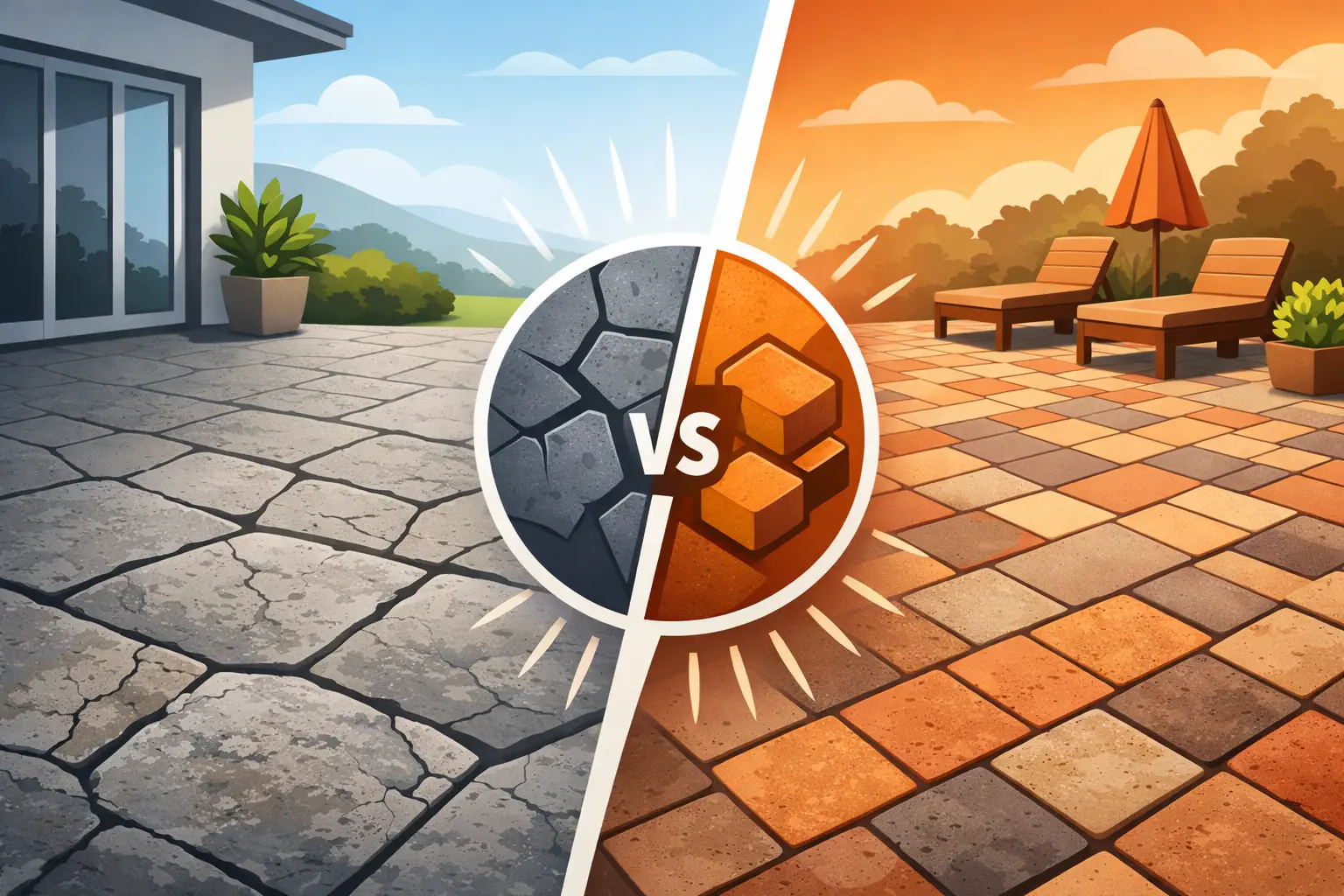
A patio can look great on day one and still become the wrong choice if it stains easily, shifts, or costs more to repair than you expected. That is why stamped concrete vs pavers is not just a style decision. It is a long-term choice about appearance, upkeep, and how your outdoor space will perform under real use.
For homeowners and property managers, the better option depends on how the space will be used, how much maintenance you want to deal with, and what kind of finish fits the property. Both materials can deliver strong curb appeal. The difference is in how they get there and what they ask from you over time.
Stamped concrete vs pavers at a glance
Stamped concrete is a poured slab with texture and pattern added to imitate stone, brick, tile, or other materials. It gives you a continuous surface with a decorative finish, often at a lower upfront cost than pavers. It works especially well when you want a clean, unified look for a patio, pool deck, or walkway.
Pavers are individual units installed over a prepared base. They can be made from concrete, brick, or natural stone, and they create a segmented surface with joints between each piece. That installation method usually costs more, but it also gives pavers an edge in repair flexibility and long-term movement.
If you want the short version, stamped concrete usually wins on initial price and a smooth custom look. Pavers usually win on repairability, movement tolerance, and premium appearance. The right answer depends on where the surface is going and what matters most to you.
Cost: upfront price vs long-term value
For many projects, stamped concrete comes in lower on initial installation cost. Because it is poured as one slab, labor can be more efficient than placing and leveling hundreds of individual pavers. If your goal is to upgrade a backyard patio or expand outdoor living space while staying on budget, stamped concrete is often attractive for that reason.
Pavers typically cost more at the start because installation is more labor-intensive and base preparation has to be precise. Material choices also vary widely, and premium pavers can push the budget up fast. That said, the higher upfront cost can make sense if you value easier spot repairs and a surface that handles minor shifting better.
This is where many people make the mistake of comparing only the estimate and not the lifecycle. A lower installation cost does not always mean lower ownership cost. If a stamped slab cracks in a visible area, repair can be difficult to hide. If a paver section settles or gets damaged, those units can often be lifted and replaced without redoing the whole surface.
Appearance and design flexibility
Stamped concrete has come a long way. When installed well, it can create a convincing stone or brick look while keeping the surface visually clean and cohesive. It also offers a lot of flexibility in color and pattern, which makes it useful when you want a tailored design without mixing multiple materials.
That said, stamped concrete is only as good as the workmanship behind it. Pattern alignment, color application, edge detail, and sealing all affect the final look. Poor installation tends to show quickly, especially in large open areas.
Pavers have a different visual character. Because they are individual pieces, the surface naturally has more texture and variation. Many property owners prefer that because it feels more upscale and more closely resembles traditional hardscape materials. Pavers can also be arranged in different laying patterns, which gives you another layer of design control.
If you prefer a sleek, continuous finish, stamped concrete may feel like the better fit. If you want a more classic, high-end hardscape appearance with visible joint lines and dimensional texture, pavers usually stand out more.
Durability in real-world conditions
Both materials can last for years when installed correctly, but they respond differently to stress.
Stamped concrete is strong, but it is still a slab. That means cracking is always a possibility. Control joints help manage where cracks may occur, but they do not eliminate the risk. Weather changes, ground movement, tree roots, drainage issues, and heavy loads can all affect performance. For patios, stamped concrete often performs well. For driveways, the demands are higher, and the quality of subgrade preparation matters even more.
Pavers are built to move a little. Because they are individual units over a compacted base, they can handle minor ground movement better than a continuous slab. They do not crack in the same way stamped concrete does. Instead, you are more likely to see isolated settling, edge movement, or weed growth in joints if the installation or maintenance is poor.
In areas where soil movement or drainage concerns are common, pavers often offer more forgiveness. In stable conditions with proper installation, stamped concrete can still be an excellent choice, especially for decorative patios and walkways.
Maintenance and repairs
This is one of the biggest practical differences in stamped concrete vs pavers.
Stamped concrete usually needs periodic sealing to help protect color and surface wear. It should also be cleaned carefully, especially if it is around furniture, grills, or vehicles where staining can happen. Once wear, chipping, or fading starts to show, refreshing the appearance may require resealing or more noticeable repair work.
Repairs are the weak point for stamped concrete. Patchwork is possible, but matching color and texture perfectly is difficult. Even a structurally sound repair may remain visible. If the damaged area is prominent, that matters.
Pavers also need upkeep, but the maintenance is different. Joint sand may need attention over time, and weeds can appear if joints are neglected. Sealing is optional in some cases, though many owners choose it to deepen color and reduce staining. The biggest advantage is repair simplicity. If one section stains badly, chips, or settles, the affected pavers can usually be replaced without changing the rest of the surface.
For property owners who want a cleaner path to long-term repairs, pavers often make life easier.
Comfort, traction, and day-to-day use
The best surface is not always the one that looks best in photos. It has to feel right underfoot and work for the way you use the space.
Stamped concrete can be easier to move patio furniture across because of its continuous surface. It can also create a polished backyard feel that works well with outdoor dining and entertaining. Some finishes, however, can become slick when wet if the texture and sealer are not chosen carefully.
Pavers generally offer good traction because of their texture and joints. They can be a strong fit around pool areas and walkways where slip resistance matters. On the other hand, the jointed surface may feel a little less smooth for rolling carts or certain furniture types.
For patios, both can work very well. For driveways, pavers can offer a visual upgrade and repair advantage, while stamped concrete may be a more budget-conscious way to create a decorative surface if the base and drainage are handled correctly.
Which one is better for your project?
If your top priority is getting a decorative patio or walkway with strong visual impact at a lower initial cost, stamped concrete is often the better fit. It delivers a custom look, works well with many home styles, and can create a clean finished space without the price tag of premium paver systems.
If your top priority is long-term flexibility, easier repairs, and a more traditional hardscape appearance, pavers are often worth the higher investment. They are especially appealing for high-visibility spaces where replacement options matter and where a segmented system may handle movement better.
There is also a middle ground. Some properties benefit from using stamped concrete in one area and pavers in another, depending on function, visibility, and budget. A backyard patio may be ideal for stamped concrete, while a front entry or feature walkway may benefit from the detail and texture of pavers.
For many customers, the smartest move is not asking which material is universally better. It is asking which material is better for this property, this layout, and this budget. That is the approach Greenstone Landscaping Co takes with hardscape planning, because the right install should look good now and still make sense years from now.
When you are choosing between stamped concrete and pavers, focus less on trends and more on how you want the space to perform. A surface that fits your budget, your style, and your tolerance for upkeep will almost always be the better investment.